
Brad Templeton Home
Robocars
Main Page
Brad Ideas
(My Blog)
Robocar Blog
My Forbes Articles
(Book from 2008)
The Case
Sidebars: Charging
The Decline of Mass Transit
When robocars arrive, what happens to transit? I was disturbed to learn just how inefficient transit systems are in the USA. A train packed with people is efficient, but that's something you only see at rush hour. That same train often goes the other way empty, and runs all day at much lower loads. Buses are even worse.
In order for transit to attract riders, it must be frequent. But to be frequent means emptier vehicles. If it's run optimally -- which is to say mostly full -- it's less pleasant.
Transit also starts and stops all the time, and it often doesn't go directly from A to B, also making it less efficient, and less useful in modern cities where trips not involving the central hub are the majority of trips.
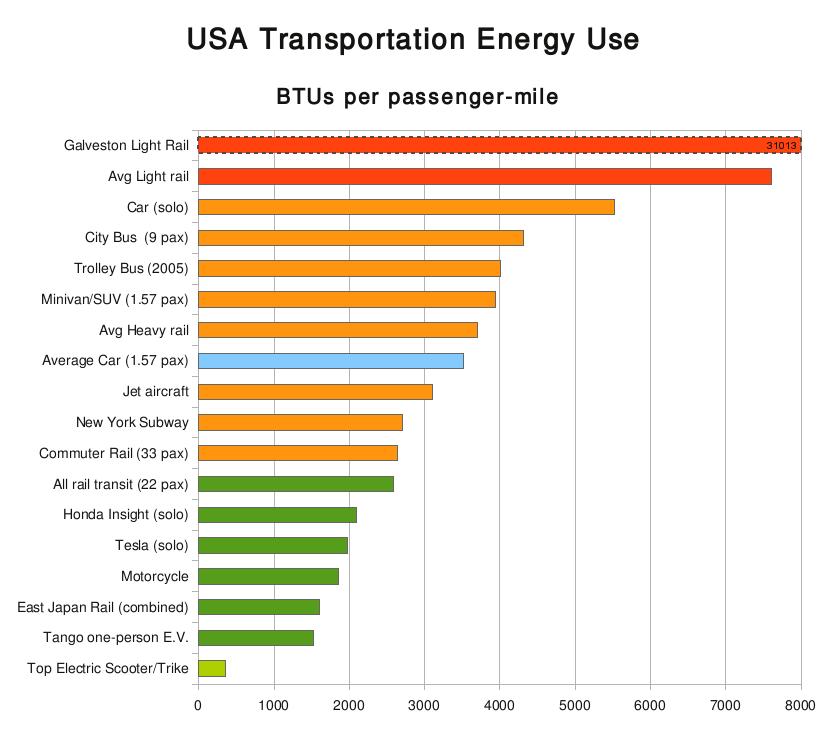
Transportation efficiency in the USA gets measured in BTUs per passenger mile. A BTU is the old energy unit, and it's close to a kilojoule. 3500 are a kilowatt-hour (with 100% efficient conversion.) But you don't need to know that, you just need to compare.
I have a new vision for the future of transit which can be read at the future of transit.
The U.S. government bureau of transportation statistics figures and the DoE Transporation Energy Data Book (Especially table 2-12) say passenger cars average about 3500 BTUs/passenger mile. (That's 35 passenger-mles/gallon and does not include trucks/SUVs) Car detractors say this number doesn't cover some of the externalities of getting fuel to cars, and suggest a number closer to 5,300. Cars are the enemy of transit of course, so you would imagine transit is much more efficient.
It isn't. In fact, the numbers for a typical city bus in the USA are about the same as for a car. That's thanks to those mostly empty city buses you see on the streets outside of rush hour. Streetcars do better in most cities, but in bad cities, like my own San Jose, the light rail comes in at over 7,000 BTU/pm -- much worse than the car.
Our aging fleets of transit buses get from 4 to 6mph of diesel. You can see immediately that with an average of 9 passengers they are not even beating out a solo driver in a Prius. Buses and light rail cars weigh a lot. A lightly loaded vehicle is moving more iron per passenger than an efficient car, and is starting and stopping more. In spite of intuitions it's just not very efficient.
 (This doesn't mean it's not green to try to take the light rail that's
already there, as
the incremental cost of carrying you is much lower. It just sums up
the overall efficiency of the whole system, and is guidance on what
systems to build.)
(This doesn't mean it's not green to try to take the light rail that's
already there, as
the incremental cost of carrying you is much lower. It just sums up
the overall efficiency of the whole system, and is guidance on what
systems to build.)
Subways and commuter rail do better, and a few of the best ones get down to closer to 1,000 BTU/pm. But even ones you might expect to do well, like the New York subway, are only a little better than cars.
You can read a more detailed energy on the myth of transit being green for more details, and the story behind the numbers.
But then I looked at the lightweight electric vehicle, which is what the robocar should eventually be for modest urban trips. Remarkably, a small scooter or electric tricycle gets below 100 BTU/pm (charger to wheels) or 275 power plant to wheels. That's a factor of 4 better than the best transit, and almost 30 times better than the worst.
Current electric cars like the Tesla roadster - aimed at holding 2 people and having a decent range, come in about 1900 BTU/pm. Still much better than most transit systems. But our robocars, which need hold only one, need not go at highway speeds and need not carry a lot of battery, will be able to do much better. Nobody has built these vehicles but I think 700 is quite attainable -- better than the best transit.
Why do people take transit, and why do they take private cars? By and large, the robotaxi has every advantage that either system can name. It's a greener, cheap trip with no parking or fueling hassle. You don't have to own a car or have a licence. It will have an extremely low collision rate, and you can read or work during the trip. Further in the future, it will be free of congestion as well.
That's about every transit advantage, except perhaps the social nature of a group of people who meet on the daily train. Transit can bypass congestion if it gets a very expensive private right-of-way -- but so can robocars. (Full transit buses pack more people per unit of road space -- more on that later.)
On the other hand, the robotaxi is private and goes directly from door to door with few stops. It's comfortable, quiet and does not require exposure to weather or long walks to stations. It runs 24/7 and will provide a faster trip than a typical transit system. The time will be predictable, with no transfers or waiting, and a guaranteed seat. It will be customized to you and is safe from crime and, let's face it, homeless people. That's about every advantage a private car has. And it will run without special subsidies (other than existing roads) and needs no special right of way.
What reason can there be to maintain mass transit in the face of a choice like this? Who would ride it? And as people move away from it, it will just get less green, run less frequently and be more expensive. (One exception, certain very crowded rush hours, is discussed elsewhere.)
CO2
The Energy Information Administration in DOE cites 1.348lbs CO2 per kwh, or 49lbs CO2 for 125,000 btus. Gasoline is 25lbs CO2 for 125,000 btus (gallon.) This means electric vehicles need to be twice as efficient as gasoline ones when it comes to emissions. The generation and transmission losses which account for this difference are already included in the BTUs/passenger-mile figures shown here, so it balances out. (About 70% of electricity in the USA is generated from fossil fuel, the rest is mostly nukes, then hydro.)
Lightweight electric cars/scooters can be up to 13 times more efficient than today's gasoline cars, and about 7 times more efficient than solo hybrid gasoline cars.
So what use?
Urban mass transit probably fades away in the robocar era, particularly outside rush hour. However, there will still be demand for intercity mass transit, and of course airlines. An intercity train, which offers the ability to walk around as it rides on smooth rails, has attractions that overcome its downsides -- starts and stops, and having to wait or schedule yourself around when it runs. (Getting to the train station will be easy in your robocar.)
To reduce wait times, on-demand robo-jitneys may make sense. A jitney is a taxi that takes multiple people with different destinations. In this case, passengers would get in short-range robocars which all converge at one location to transfer to a bus or van (or train) just for those people. It takes them non-stop to the area they all wish, where robotaxis are waiting to take them the last mile to their destinations. This is almost like a non-stop ride, and it is more efficient. It will be sufficiently full to be more efficient, or it won't run -- instead smaller vehicles or single passenger ones will run, forming drafting trains on the highways.
The robo-jitney might be quite different from today's intercity bus, which is mostly aimed at the lower-income carless. High end robo-jitneys might be built of small cabins where the passengers can work in privacy, or sets of facing seats where they can socialize.
The long haul robo-jitney is probably diesel, biodiesel or CNG powered, but since it will go non-stop on highways, it will run fairly efficiently.
It does make sense, from a congestion and efficiency standpoint, to run buses and trains just at rush hour. But could we justify the cost of such big vehicles and their tracks for such limited usage? (At least with robotransit you don't need to employ drivers for just a few hours work a day. Even today, the best way to run a bus line would be to run big articulated buses at rush hour, and switch to small vans the rest of the day, but nobody can afford the physical plant and the extra drivers.
Naturally, lots of transit infrastructure already exists, and will be used because it exists, even if future economics would not dictate the building of such transit. Existing transit lines will probably maintain exclusive right-of-way (and thus have a trip-time advantage) even though it might make more sense to allow more vehicles on lightly-used ROW. In addition, it costs money to adapt pure rail ROW to use by typical street vehicles, and the lack of ability to pause or pass on rails causes additional problems.
(It is sometimes suggested that because often federal/state funds will pay for transit infrastructure like buses, while local funds pay for drivers, that transit decisions are biased towards having fewer, bigger vehicles when riders would clearly prefer more frequent, smaller ones. Robocars could change this, but is it enough?)
The congested street
The most efficient transit lines, such as New York's subway, are capable of excellent capacity in passengers/hour. And when they are at that high capacity they are also highly efficient. Places that have built rail lines like this are likely to keep using them, and many of them don't have the road capacity available to move the transit users into robotaxis.
Road use patterns are heading for a change, and not just due to robocars. Large efforts are underway to use data services in cars to improve traffic. Robocars also offer the potential to get a lot more cars on the same roads, particularly as the number of human driven vehicles and non-connected human driven vehicles drops. There are also some extreme improvements possible in the more distant future when human driven cars are rare, or are even barred from certain roads.
Even without that, the potential for robotic bus transit is quite high. The best heavy rail (subway) lines are rated at 40,000 passengers/hour -- though nobody has a seat. Robotic buses with 60 seated passengers and 1 second headway -- an extreme case to be sure -- could send 216,000 people per road lane. A more realistic vision of 12 person vans as I describe above with 1.5 second headway offers 28,000 comfortably seated people in that single lane of road.
You can read my article on the future of congestion for a vison of how to vastly increase road capacity using connected and robotic small cars once their penetration is high.
The Airplane
Airplanes (which have been flown by computers for years) are mass transit. They aren't particularly efficient. They get about 50 passenger miles/gallon, and thus take about as much fuel as 2 people in a typical car, or one in a hybrid. Computers can't do much about that, though perhaps carbon neutral fuels can.
However, airports may be changed by robocars. Airport security muddles this question, but without it, we could see airports that were just pieces of tarmac. Passenger's robocars would zoom them right to the plane and they would quickly board, then fly to find robotaxis waiting on the airfield at the other end. Deliverbots would take the checked luggage to any hotel or home. This is a great dream if we can get rid of the security bottleneck.
Now consider more random notes.